Exploring .NET Journey: Awaiting .NET 8
Take a fun-filled rollercoaster ride through the history of C# and .NET, from their humble beginnings to the latest and greatest features in .NET 8. Join me as I reminisce about the old days, celebrate the changes along the way, and get hyped for what's coming next in the world of .NET development! 🚀

While the tech world awaits for .NET 8, it’s an opportune moment to take a step back and reflect on the transformative journey of C# and .NET. Their evolution was not just a testament to Microsoft’s vision but also the dynamic and ever-changing demands of developers worldwide. This article offers a whirlwind tour of their metamorphosis, highlighting key milestones, and setting the stage for the exciting innovations .NET 8 promises to bring.
💡 Quick answers: Jump to frequently asked questions about .NET.
How it all began
.NET Framework 1.0
Released in 2002, .NET Framework 1.0 was Microsoft’s answer to a changing software development landscape, aiming to provide a unified environment for developing web services, desktop applications, and other software. The first release included many of the key features that are still being used today, even if they’ve changed as time went by, these were:
- CLR: Common Language Runtime
- BCL: Base Class Library
- ASP.NET: For web-based applications, introducing WebForms which allowed for event-driven web development
- ADO.NET: A set of classes for data access, offering disconnected data architecture and XML integration
- Windows Forms: For building rich desktop applications and even with the release of WPF or .NET MAUI they’re still being used
- Support for multiple languages: One of the main advantages was its ability to support multiple languages, ensuring interoperability
As you can see, even though .NET platform is constantly changing and evolving, the key features were a fundament for what we have today, which is being polished till this day. We’ve talked about the platform and now you might be wondering what did C# 1.0 had to offer back then?
C# 1.0
Introduced alongside .NET Framework, C# 1.0 became one of the primary languages designed for the platform. Anders Hejlsberg, who also worked on Turbo Pascal and Borland Delphi, was a chief architect behind C#. As you may guess, C# 1.0 was not so rich on features as today, but in the same way as .NET Framework 1.0, it already had all the key concepts included that we’re still using to this day and they’re nowhere to go.
- Object-Oriented: Full support for classes and the three pillars of Object-Oriented programming (inheritance, polymorphism and encapsulation)
- Syntax, which was heavily influenced by Java and C++, but with a focus on simplicity and productivity, which was also related to the next key feature
- Garbage collection: Automatic memory management to avoid common programming pitfalls
- Type-Safety: C# is designed to be strongly typed to minimize runtime errors and enhance performance
- Declarative programming: Attributes in C# allow developers to add metadata to assemblies, classes etc., which could be then queried at runtime using reflection
What has changed
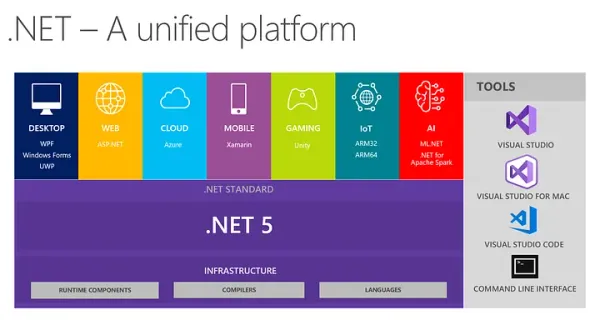
Although .NET Framework and C# went a long way and there was a ton of features added year to year, the major changed happened in November, 2020, when .NET 5 was released. You might be asking, what did it change for us, developers? Well, let’s see:
- Consolidation of .NET Core and .NET Framework: .NET 5 was a successor to .NET Core 3.1, it brought an end to the separate .NET Core branding. It’s not here to continue what .NET Framework is, but to represent the path forward for the .NET platform as a whole.
- Unified Platform for Different Workloads: .NET 5 allows developers to target various application types such as web, cloud, mobile, gaming, IoT and AI using a single .NET platform.
- Cross-Platform Support: .NET 5 maintained and improved upon .NET Core’s commitment to cross-platform development, enabling developers to run their applications on Windows, Linux and MacOS.
All of this sounds pretty cool, although .NET 5 didn’t bring us any GUI development libraries which were cross-platform and existing ones like WinForms or WPF remained Windows-only technologies.
.NET 6/7
In terms of major changes, there were not so much features offered with .NET 6/7 releases as in previous versions, but they both provided significant performance improvements and also, we finally have a technology for making GUI applications cross-platform, although, still not possible for Linux. What I’m talking about is - .NET MAUI, which is pretty good, but comes with some caveats.
- Yes, you have a cross-platform GUI technology, but Linux is still missing out.
- Yes, you have the ability for AOT compilation to run basically on bare metal, without .NET Runtime installed at all, but not for cross-platform apps, this is still a Windows-only feature.
- And last one, .NET MAUI is actually pretty good, but you have to write it’s styling and markup using HTML & CSS, which might be a plus for someone, although old C# developers might be more used to WinForms style or XAML.
What to Expect

Even though .NET 8 is set to release in November, 2023, we already can try it out! Yes, the RC1 is already available and it has a lot to offer, including things like Native AOT for Web applications, Blazor improvements and Entity Framework updates, make sure to check out all the benchmarks (really big performance improvements) and RC1 notes. From the revolutionary advancements in Web application development to performance leaps, .NET 8 promises a transformative experience for developers. So why wait? Dive into the RC1 today and be among the first to feel the power of the future of .NET!
💡 Frequently Asked Questions
What are the biggest changes in .NET 8 compared to previous versions?
Why was .NET 5 such a major milestone in .NET’s evolution?
What is .NET MAUI and how does it change cross-platform development?
Thank you for taking the time to read :)
If you enjoyed the article, you’re welcome to join the Discord community.